Here is a link to my evaluation which i did on Microsoft PowerPoint. Then i uploaded it to slideshare.
http://www.slideshare.net/jordan_howell_media/jordan-howell-as-media-evaluation-2012
Friday, 20 April 2012

Thursday, 19 April 2012
My Preliminary
Here is my preliminary video that i created in my research and my planning. This helped me make my final product as it taught me to be confident with the equipment and made me know what to do so the final production was smoother when creating. Without doing this i don't think my production wouldn't look like it did as the experience was key to the success.
Alone | My AS Final Opening Sequence Video
Here is a link to my final production on youtube. I am very happy with what i created especially as i decided not to use dialogue, but i still got across the intended feelings to the audience. I am happy of this. I also believe i used my research well in making my video and took everything i learnt on board when creating it. I followed most of the codes and conventions but still challenged some to make my production different.
Thursday, 15 March 2012
Distributors Planning

Distributors Research
Although i have done some planning i went back and done some research on companies that would distribute my product. I looked at three films and what companies distributed them.
When a Stranger Calls
Is distributed by Touchstone Pictures, and was distributed on DVD and cinema formats.


This all helped me as i could see the distributors of over film in my genre and then pick one which would distribute my film.
When a Stranger Calls
Is distributed by Touchstone Pictures, and was distributed on DVD and cinema formats.

Taken
Is distributed by 20th Century Fox, and was distributed on DVD and cinema formats
The Silence Of The Lambs
Was distributed by Orion, and was distributed on DVD and cinema formats

This all helped me as i could see the distributors of over film in my genre and then pick one which would distribute my film.
My Production Company Intro
I did some intensive research on production companies and there intros. this lead me to create a production company and a intro for them to make my opening sequence more professional and following the codes and convention of other production company intros for thrillers)


This is what i came up with, a natural thing (salt and pepper) which was a code and convention i found in the production companies (clouds). And made the words fly in like i also found that other production companies did. i overall think it wen very well.
Storyboard
I did a story board so i could iamge the shots and then make my recroding process simpler, i then after words re-did my story board wiht picture form the final piece to make it look more proffesional.


Sunday, 4 March 2012
Outfits

Saturday, 21 January 2012
Location
I had two locations in mind after i came up with my story line.
Mentmore Woods

The trees here are thin and close together, but it meant there wouldn't be a lot blocking my shots and the ground is quite sturdy.
Ashridge Woods
 The trees are spread out more here, but the ground is very rough which could be a health and safety issue and also looks like your going up a mountain.
I decided to go with Mentmore Woods as it is closer, and is will be a better scenery for my production.
Equipment
Here is the list of the equipment i am going to use for my production, that includes filming and editing.
Kodak Playsport Zx3 (1080p) - The reason i decided to use this camera is that it is a very durable camera, and as I'm filming in the woods, if i drop the camera it wont break and also mud could get in to it. It also produces 1080p picture witch is full quality HD. I want my opening sequence to look crisp and have a lot of detail in the shots. It also has a very clear microphone so i wouldn't have to use and external one
Two Lithium Batteries - I am using lithium batteries as they last for a lot time, but as I'm filming in 1080p i will be using two just in case one runs out while filming.
Hamastar 63 Tripod - This tripod is very sturdy and can also go very tall, it also comes with its only carrying bag so it is very portable and wouldn't be a problem taking it in to the woods.
Apple imac - I used an imac to upload my video on two as it is very fast and also very clear to use.
Apple imovie - I used apple i move to edit my video as it has a lot of very helpful tools and can remake a video look very professional. Also i got to have a tutorial on how to edit videos on imovie witch really helped me out.
USB Cable - This is used to transfer my video on too the imacs
imovie ilife Sound Effects - I want to use this on my video as it is copyright free sounds that will enhance my video.
Costumes - I had to make the actors wear very specific stuff to make it more authentic.
Kodak Playsport Zx3 (1080p) - The reason i decided to use this camera is that it is a very durable camera, and as I'm filming in the woods, if i drop the camera it wont break and also mud could get in to it. It also produces 1080p picture witch is full quality HD. I want my opening sequence to look crisp and have a lot of detail in the shots. It also has a very clear microphone so i wouldn't have to use and external one
Two Lithium Batteries - I am using lithium batteries as they last for a lot time, but as I'm filming in 1080p i will be using two just in case one runs out while filming.
Hamastar 63 Tripod - This tripod is very sturdy and can also go very tall, it also comes with its only carrying bag so it is very portable and wouldn't be a problem taking it in to the woods.
Apple imac - I used an imac to upload my video on two as it is very fast and also very clear to use.
Apple imovie - I used apple i move to edit my video as it has a lot of very helpful tools and can remake a video look very professional. Also i got to have a tutorial on how to edit videos on imovie witch really helped me out.
USB Cable - This is used to transfer my video on too the imacs
imovie ilife Sound Effects - I want to use this on my video as it is copyright free sounds that will enhance my video.
Costumes - I had to make the actors wear very specific stuff to make it more authentic.
Scripts
There will be no dialogue in my opening sequence The reason for this is that i don't want to give too much away, and i want the audience to think about what is happening and try to make there own conclusions on the events unfolding in front of them.
It is quite a hard thing to accomplish giving people feelings without dialogue so i am hoping that i can create it using camera shots and non-diegetic sound.
But i am going to use breathing so they know the person is still there for point of view shots.
It is quite a hard thing to accomplish giving people feelings without dialogue so i am hoping that i can create it using camera shots and non-diegetic sound.
But i am going to use breathing so they know the person is still there for point of view shots.
Actors
The specifications of my main character are:
Gender - Male
I want the main character to be a male, as i think it will mean the story makes more sense, as getting caught in the woods and your a female the audience will automatically assume rape so might not want to watch it, but whereas a male getting caught in the woods can lead to many different thing, so it will keep the audience guessing and hopefully make them want to watch more.
Age - 16-18
I have made the character quite young for a couple of reasons. One being that the younger the person is the more sympathy the audience will give them, and secondly the younger they are the less knowledge they might have so it makes the story more believable. Also if i make the person young it can lead on to more films in the series.
Height - 5'7 or below
This is because i want them to be quite small to make the audience emphasise more with him as they associate small with helpless and more of an easy target.
Ethnicity - Caucasian
Hair Colour - Blonde
Blonde is a hair colour associated with sweet Innocent people. I want this to come across to the audience as then subconsciously then start to emphasise with him more, and i want this to happen to make what happens to him have a bigger impact on the viewer.
I decided to use one of my friends James Graham as an actor as he fitted all of the specifications, and could film on my planned filming days.
Gender - Male
I want the main character to be a male, as i think it will mean the story makes more sense, as getting caught in the woods and your a female the audience will automatically assume rape so might not want to watch it, but whereas a male getting caught in the woods can lead to many different thing, so it will keep the audience guessing and hopefully make them want to watch more.
Age - 16-18
I have made the character quite young for a couple of reasons. One being that the younger the person is the more sympathy the audience will give them, and secondly the younger they are the less knowledge they might have so it makes the story more believable. Also if i make the person young it can lead on to more films in the series.
Height - 5'7 or below
This is because i want them to be quite small to make the audience emphasise more with him as they associate small with helpless and more of an easy target.
Ethnicity - Caucasian
Hair Colour - Blonde
Blonde is a hair colour associated with sweet Innocent people. I want this to come across to the audience as then subconsciously then start to emphasise with him more, and i want this to happen to make what happens to him have a bigger impact on the viewer.
I decided to use one of my friends James Graham as an actor as he fitted all of the specifications, and could film on my planned filming days.
What Title To Use?
I have come up with titles for my film and here they are:
Sacrifice
Alone
Finder
Special
Wooded
I felt that these titles coincide with my research on thriller films and thriller films titles, and that when you hear the titles they connote the codes and convention of thriller films that i researched.
 I have decided to use the title Alone as it is very broad so doesn't give to much away, but can also make a connection to the audience about them thinking about the feeling of being alone and the feeling of depression.
Sacrifice
Alone
Finder
Special
Wooded
I felt that these titles coincide with my research on thriller films and thriller films titles, and that when you hear the titles they connote the codes and convention of thriller films that i researched.

Scheduling
I decided i would make a schedule to make the production process less complicated. As i saw in my research that by planning the production more it make it simpler to create and makes the whole process smoother.
November
1st-10th Get told brief and construct the preliminary video.
11th-20th Plan my main task.
21st-22nd Look at potential locations to shoot, and give them a safety check.
23rd-25th Decide on what actors, locations, props, costumes i will be using.
26th-27th Do a complete storyboard of the opening sequence, to make filming simpler.
28th Film my opening sequence on location.
29th Check over all footage.
30th Film more in necessary
December
1st-10th Edit all of the shots together.
11th-13th Edit the soundtrack and add on background music.
14th-15th Add a production company and text.
16th-20th Watch back and make adjustments if needed.
November
1st-10th Get told brief and construct the preliminary video.
11th-20th Plan my main task.
21st-22nd Look at potential locations to shoot, and give them a safety check.
23rd-25th Decide on what actors, locations, props, costumes i will be using.
26th-27th Do a complete storyboard of the opening sequence, to make filming simpler.
28th Film my opening sequence on location.
29th Check over all footage.
30th Film more in necessary
December
1st-10th Edit all of the shots together.
11th-13th Edit the soundtrack and add on background music.
14th-15th Add a production company and text.
16th-20th Watch back and make adjustments if needed.
First Ideas
I have came up with two first ideas for my opening sequence:
Idea One
The main character believes in republicism and anti-monarchy. The radio comes on in an investigation room with very dark lighting saying that someone has attempted to assassinate the queen. The camera than pans over to the file folder of the main suspect in a point of view shot and there is a picture of the suspect in an ally way. The camera then zooms in on the photo until it fits the whole frame and then whats in the picture starts moving and it is the next shot. That shot of the person in the alley is from a security camera, so the camera would be panning left and right, and it would be fuzzy then it would zoom back out to the investigation room and then pan over to a computer screen where there is a website up which belongs to the main suspect and then it zooms into this as there is a video on it and once the video fits the frame it starts playing and it is a message from the main suspect speaking face on with the camera admitting to the crime and also saying "this time it might be an attempt but next time... well you'll see" it then fades to black.
Idea Two
An establishing shot of the woods and then it turns to black. Then there are some montage editing of point of view shots of running through the woods with the persons breathing clear in the sound. It then goes to shots of the person running through the woods with different camera angles and distances. This could be the view of different animals in the woods. This will happen for a few shots then it will cut back to point of view shots and you see from the characters point of view him running and then tripping and falling. Then there will be a black screen for about 2-4 seconds and then it will have a blurred point of view shots happen really quick as to see the person have blurred vision while waking up blinking. Then it will still be a point of view shot of the person being dragged and you can see his arms in front of the camera. With a heavy heartbeat in the background. It then goes to black as to be the person closing there eyes and then when opening them with another point of view shot you see a man putting a bag over his head. It then rewinds all the way back through the clips to the begging where present day flashes up. Through out this both people faces are not shown.
Comments
Before making the decision asked people their views on both ideas to get some potential customer feedback before deciding to make one of the films.
Idea One:
Overall i will take this information in when making my final decision.
Which Idea?
I have decided to use Idea Two as i enjoy seeing point of view shots and i think i will be able to make this look more professional. I also like the fact that there is no dialogue, which can give the audience time to think about what is happening and come up with ideas of what is/will happen. The re-wind also will be fun to put in as i haven't seen it in a lot of films and i think it will confuse people and leave them wanting to watch more. The different camera shots which could be seen as from animals sounds interesting as it could be a very unusual concept that people might not even pick up when watching the opening sequence. I also like the fact that the audience wont know the identity's of both the people, so they may want to watch more to see who they are and what they fully look like.
I didn't use idea one as although i like the idea of zooming in on different things that started playing and the shot from the security camera, i think it is too complex for me to to efficiently and also might come across as amateur after edited.
Idea One
The main character believes in republicism and anti-monarchy. The radio comes on in an investigation room with very dark lighting saying that someone has attempted to assassinate the queen. The camera than pans over to the file folder of the main suspect in a point of view shot and there is a picture of the suspect in an ally way. The camera then zooms in on the photo until it fits the whole frame and then whats in the picture starts moving and it is the next shot. That shot of the person in the alley is from a security camera, so the camera would be panning left and right, and it would be fuzzy then it would zoom back out to the investigation room and then pan over to a computer screen where there is a website up which belongs to the main suspect and then it zooms into this as there is a video on it and once the video fits the frame it starts playing and it is a message from the main suspect speaking face on with the camera admitting to the crime and also saying "this time it might be an attempt but next time... well you'll see" it then fades to black.
Idea Two
An establishing shot of the woods and then it turns to black. Then there are some montage editing of point of view shots of running through the woods with the persons breathing clear in the sound. It then goes to shots of the person running through the woods with different camera angles and distances. This could be the view of different animals in the woods. This will happen for a few shots then it will cut back to point of view shots and you see from the characters point of view him running and then tripping and falling. Then there will be a black screen for about 2-4 seconds and then it will have a blurred point of view shots happen really quick as to see the person have blurred vision while waking up blinking. Then it will still be a point of view shot of the person being dragged and you can see his arms in front of the camera. With a heavy heartbeat in the background. It then goes to black as to be the person closing there eyes and then when opening them with another point of view shot you see a man putting a bag over his head. It then rewinds all the way back through the clips to the begging where present day flashes up. Through out this both people faces are not shown.
Comments
Before making the decision asked people their views on both ideas to get some potential customer feedback before deciding to make one of the films.
Idea One:
- "Sounds Complicated"
- "If pulled of will be very effective"
- "Has an interesting story line"
- "Feel like i know what will happen at the end already"
- "Would feel like i was in the investigation"
- "Seems to have a lot of mystery"
- "Would want to know who these two people are"
- "Interesting, as it would make me feel like i am the person"
- "With all the moving shots may get confusing for my eyes"
- "Seems more like a film i would watch"
Overall i will take this information in when making my final decision.
Which Idea?
I have decided to use Idea Two as i enjoy seeing point of view shots and i think i will be able to make this look more professional. I also like the fact that there is no dialogue, which can give the audience time to think about what is happening and come up with ideas of what is/will happen. The re-wind also will be fun to put in as i haven't seen it in a lot of films and i think it will confuse people and leave them wanting to watch more. The different camera shots which could be seen as from animals sounds interesting as it could be a very unusual concept that people might not even pick up when watching the opening sequence. I also like the fact that the audience wont know the identity's of both the people, so they may want to watch more to see who they are and what they fully look like.
I didn't use idea one as although i like the idea of zooming in on different things that started playing and the shot from the security camera, i think it is too complex for me to to efficiently and also might come across as amateur after edited.
Research On Potential Target Audience
I decided i would research my target audience before i started filming, so i could then use it as a tool to the way i shoot my opening sequence.
Age: 15-30
Because there will be a lot of violence in the film, but it will not be overly explicit to make it and 18 rated film. Conventions of thriller films are 15 or 18 rated so by making my production a bit tamer it means i can expand my target audience which will hopefully increase revenue from film sales.
Gender: Male
Although males and females will like my opening sequence, the action/thriller genre is seen as more of a male genre, whereas in comparison the romantic genre is seen as more or a female genre. My research showed me this as i asked my friends and family what genre they preferred and every four males to every one female said thriller.
Personality: Likes being scared but also taken on a journey through the film.
With a action/thriller film i want to aim to thrill people and make some parts quite dark but also to give it a lot of action an a journey to go along with the action. So that is why i think the target audiences personality will like to be taken on journeys through the form of a film and also like the feeling of being scared. Although all over personality will hopefully still enjoy it. My research showed me this as people who find being scared boring told me that they would watch thriller films and also people who said they like a love story said they also wouldn't watch it so that's how i came up with my personality codes and conventions of thrillers.
Overall this helped me see what my target audience is, as by looking at what type of people watch thrillers i could then generate my target audience (as seen above)
Age: 15-30
Because there will be a lot of violence in the film, but it will not be overly explicit to make it and 18 rated film. Conventions of thriller films are 15 or 18 rated so by making my production a bit tamer it means i can expand my target audience which will hopefully increase revenue from film sales.
Gender: Male
Although males and females will like my opening sequence, the action/thriller genre is seen as more of a male genre, whereas in comparison the romantic genre is seen as more or a female genre. My research showed me this as i asked my friends and family what genre they preferred and every four males to every one female said thriller.
Personality: Likes being scared but also taken on a journey through the film.
With a action/thriller film i want to aim to thrill people and make some parts quite dark but also to give it a lot of action an a journey to go along with the action. So that is why i think the target audiences personality will like to be taken on journeys through the form of a film and also like the feeling of being scared. Although all over personality will hopefully still enjoy it. My research showed me this as people who find being scared boring told me that they would watch thriller films and also people who said they like a love story said they also wouldn't watch it so that's how i came up with my personality codes and conventions of thrillers.
Overall this helped me see what my target audience is, as by looking at what type of people watch thrillers i could then generate my target audience (as seen above)
Research On Soundtracks
I decided i would research some soundtracks to thriller films to see what sort of music are in them.
The music to my left is a great example of suspense music. I would use something like this which gives a mystery effect, and also builds up the tempo to the main scene.
In the music to my right, there is also a steady build up of tempo adding suspense to the audience. This is a convention of the thriller genre, and i will use music like this that is from a copyright free source.
The music to me left is more of action music then thriller, and as I'm doing a hybrid film i thought i would look at a piece of action soundtrack as well. There are is a lot more depth to the sound,and it is more meaty then the thriller soundtrack.
Overall this showed me the codes and conventions of soundtracks to thriller film and i will use everything i have learnt (suspense music, steady build up, mystery effect etc) in my final product.
Overall this showed me the codes and conventions of soundtracks to thriller film and i will use everything i have learnt (suspense music, steady build up, mystery effect etc) in my final product.

Research On Production Companys Introductions
As i wanted to make my opening sequence as professional as possible i thought i would add a production company at the beginning as every film has this.
The most iconic production company has to be Universal Studios (est.1912), and thee introduction before a film(as seen to the left) has a earth rotation with the text in front of it. I think that this represents the fact that they open up there films for the whole world to enjoy.
Dracula
The Wolf Man
Battleship
The most iconic production company has to be Universal Studios (est.1912), and thee introduction before a film(as seen to the left) has a earth rotation with the text in front of it. I think that this represents the fact that they open up there films for the whole world to enjoy.
Films:
The Bourne Identity
JawsDracula
The Wolf Man
Battleship
Columbia Pictures (est.1926) is another big production company in the genre i am concentrating on in my production. They are part of sony productions and there opening sequence shows a women holding a torch with a light sparking of the torch with clouds behind, showing heaven and connoting a feel again of a feel that is is open to everyone as it is something every country and person can see the sky. It also connotes power and lets the audience know that this production company are not messing about when making films giving the audience a sense that they are in good hands. Films include: Taxi Driver, All the kings men, Close encounters to the third kind etc.
Warner Bros. Pictures (est. 1918) have produced films like: The Shining, The Matrix, Gremlins, Harry Potters, A Clock Work Orange etc. and have a there opening sequence in front of clouds and sky connoting the same as the other two, that here films are global. Also they have very luxurious colours like gold and is very clean and shiny showing good quality.
New Line Home Entertainment (est. 1967) has a very basic introduction which has film tape flying towards a black square with a glowing blue light behind which represents them having the power and that the audience should follow (carry on watching) to find out more which makes the audience want to be taken on a ride with them. Some of there films include: Se7en, The Mask, A Nightmare On Elm Street, Friday the 13th, Final Destination etc.
Touchstone Pictures (est. 1984) produced films like The nightmare before Christmas, Armageddon and 25th Hour. Their introduction is very simple and isn't that complex, it has there name flowing across the bottom and then a spark on there logo. This shows has helped me as i don't have the equipment to make a complex introduction but can make something basic like there one.
Overall from doing this i have learnt that i should use something natural (like clouds) in my introduction and also have the text of my production company name at the begining aswell. I learnt that these are the codes and conventions of production company's introductions.
Friday, 20 January 2012
Research On Thriller Titles
I decided i would research the type of text, font, colour etc of the titles in thriller films, to gain more understanding on what mine should look like.


 North By Northwest has a big font size and like the bourne supremacy it is very squared. It has arrows in some of the letters which gives the audience some confusion.

The Bourne Supremacy's title looks very techno, connote the film is about spy's, and it gives a very official/government look. This title can show the audience the genre of the film. The font is very squared and is in a white (ish) colour. This is very helpful as it is basic but gives of a certain effect.

James Bond's Octopussy's title has big bold writing, which can connote an action film. Also the mix of red and which connotes a crime/spy thriller. Again very helpful as although basic fives of a certain feel to the audience.
 North By Northwest has a big font size and like the bourne supremacy it is very squared. It has arrows in some of the letters which gives the audience some confusion.
 It also has white writing which is very plain, and doesn't give much away.
Overall this has been very helpful, and i think i will use white coloured writing and also make it squared in my opening sequence to make it fit the thriller genre more. Also makes it fit in with there big thriller films.
 Here is my final Title, i decided to play it over the video as the establishing shot needed something extra in it. I took on board everything that i learnt in the research and used squared white font and colour.

Thursday, 19 January 2012
Codes And Conventions Of Thriller/Horror Films And Their Opening Sequences
Some Conventions of thriller films opening sequence/whole films are:
Mirrors are used in thriller films to reflect ones soul and inner self. They also represent the darkness in some characters. I am tempted to put a random crack of mirror of the floor in the forest so a camera angle can reflect from it but it will be tricky to make it seem like the segment of mirror is suppose to be in the location.
Low Key Lighting
This is to give a mystery effect to the audience, like they don't know what is happening in the darkness, and this can also add to the suspense. I intended to use this when the attacker is going over the person's body so you cant see there face, but just the fading out of the light in the background.
Shadows
Shadows are used to represent the inner darkness in people and can also add to tension and eeriness to the audience. When the character is being dragged/crawling away i might use the attackers shadow to increase the unknowing sense of the attackers features in detail but to give little hints like height, posture etc.
Obstructive Editing
This is used to add to the feelings of suspense and tension, this is also used often in particularly thrilling scenes as it can create a feeling of disorientation of time and space. I plan on using this as disorientation is an effect i want to give to my audience.
Quick Cuts
This is also used to create feelings of suspense and tension, and just like Obstructive editing it can create a felling of disorientation of time and space. All though i am not planning on quick shots from a viewers perspective but when i use the point of view shot so the audience get a person perspective they will blink creating these key effects for my production.
Changes In Camera Angles
This can create a feeling of confusion, as the camera angle will change quickly, disorientation your viewing of the film. I want to use different camera angles in my opening sequence to give some confusion, and also to make the video have more interesting shots i.e. high angled and low angled shots.
Tension Music
Obviously this will create tension for the audience and also suspense. I will use this in my opening sequence to build up the suspense to one of the big moments in my opening sequence. I believe this to be key as a good thriller/horror always has tension music in the background. Also as it is the opening sequence the tension music build up the start for the audience to make the audience want to watch more.
Stairs
Very simply stairs are in horror films to show different levels in the films and also can be used to create tension when walking up/down them. There wont be any stair as in my production as i think walking up/down them will slow down the face pace of my planned opening sequence
Flashbacks
Flashbacks can contribute to a sense of time and space disorientation, and this can confuse the audience. This can display what has happened to a characters past and and give the audience an insight into it. (I showed this in my previous post on researching thriller films)
Use Of Photographs
Photographs are used in thriller films and a insight into a characters past, and can reveal more to the audience. It is manly associated with stalkers in thriller films. I am tempted to use cutaway shots to a scene of someones house with pictures of people with there heads cut of.
Black And White
This can make a scene feel quite eerie and give a sense of darkness. This is also like the description of shadows. These are two key colours that i want to get across but more in dark and light type of way.
Disorientation Of Time And Space
This makes the audience feel confused and edgy, which can then make them venerable for a director to create fear. My planned productions is very quick with a lot of jagged shots which can create this effect
Montage Editing
This is when there are a lot of short clips in quick concession. This gives a sense of confusion and also speeds up the tempo, when added with tense music. Although this sounds like something i should do i think it will make it to fast paced and therefore annoy the audience.
- Mirrors
- Low Key Lighting
- Shadows
- Obtrusive Editing
- Quick Cuts
- Changes In Camera Angles
- Tension Music
- Stairs
- Flashbacks
- Use Of Photographs
- Black And White
- Disorientation Of Time And Space
- Montage Editing
Mirrors are used in thriller films to reflect ones soul and inner self. They also represent the darkness in some characters. I am tempted to put a random crack of mirror of the floor in the forest so a camera angle can reflect from it but it will be tricky to make it seem like the segment of mirror is suppose to be in the location.
Low Key Lighting
This is to give a mystery effect to the audience, like they don't know what is happening in the darkness, and this can also add to the suspense. I intended to use this when the attacker is going over the person's body so you cant see there face, but just the fading out of the light in the background.
Shadows
Shadows are used to represent the inner darkness in people and can also add to tension and eeriness to the audience. When the character is being dragged/crawling away i might use the attackers shadow to increase the unknowing sense of the attackers features in detail but to give little hints like height, posture etc.
Obstructive Editing
This is used to add to the feelings of suspense and tension, this is also used often in particularly thrilling scenes as it can create a feeling of disorientation of time and space. I plan on using this as disorientation is an effect i want to give to my audience.
Quick Cuts
This is also used to create feelings of suspense and tension, and just like Obstructive editing it can create a felling of disorientation of time and space. All though i am not planning on quick shots from a viewers perspective but when i use the point of view shot so the audience get a person perspective they will blink creating these key effects for my production.
Changes In Camera Angles
This can create a feeling of confusion, as the camera angle will change quickly, disorientation your viewing of the film. I want to use different camera angles in my opening sequence to give some confusion, and also to make the video have more interesting shots i.e. high angled and low angled shots.
Tension Music
Obviously this will create tension for the audience and also suspense. I will use this in my opening sequence to build up the suspense to one of the big moments in my opening sequence. I believe this to be key as a good thriller/horror always has tension music in the background. Also as it is the opening sequence the tension music build up the start for the audience to make the audience want to watch more.
Stairs
Very simply stairs are in horror films to show different levels in the films and also can be used to create tension when walking up/down them. There wont be any stair as in my production as i think walking up/down them will slow down the face pace of my planned opening sequence
Flashbacks
Flashbacks can contribute to a sense of time and space disorientation, and this can confuse the audience. This can display what has happened to a characters past and and give the audience an insight into it. (I showed this in my previous post on researching thriller films)
Use Of Photographs
Photographs are used in thriller films and a insight into a characters past, and can reveal more to the audience. It is manly associated with stalkers in thriller films. I am tempted to use cutaway shots to a scene of someones house with pictures of people with there heads cut of.
Black And White
This can make a scene feel quite eerie and give a sense of darkness. This is also like the description of shadows. These are two key colours that i want to get across but more in dark and light type of way.
Disorientation Of Time And Space
This makes the audience feel confused and edgy, which can then make them venerable for a director to create fear. My planned productions is very quick with a lot of jagged shots which can create this effect
Montage Editing
This is when there are a lot of short clips in quick concession. This gives a sense of confusion and also speeds up the tempo, when added with tense music. Although this sounds like something i should do i think it will make it to fast paced and therefore annoy the audience.
Tuesday, 17 January 2012
Research On Thriller/Horror Films
I have decided to watch the opening sequence's of some thriller films to gain a better understanding of what i should produce to fit this genre.
The Bourne Identity
 This film starts of on a boat at sea. The lighting is very dark which gives a sense of the unknown to the viewer. The camera is moving as the boat is moving which not only makes it more realistic but also make the viewer uneasy. The text comes up with the location of the boat so the audience start to gain more knowledge, but I'm not sure if i should do this for my one as i want the location to remain a mystery. It then goes on to show a body floating on the water so the fishermen bring it on board to the doctor they have on the ship. They then have a lot of close up and extreme close ups as the doctor inspects the body and gets the bullets out of the person. Then as the doctor inspects the bullet you start to see that maybe the person is a spy as the bullet has a projector on it. Then he goes back and the person is then up and he start fighting thinking he is held captive. This whole start of the film make the audience gain more information on the main character and this is what i plan on doing. They also you very subtle editing techniques so that you don't really notice it happening
The Bourne Supremacy
 This film starts with a lot of shots with dark lighting to create a tense environment for the audience. It has flash backs from the ending of the previous film (The Bourne Identity) in a slow-mo. This is clever as in can remind the audience about the ending of the previous film, but also makes them feel like they are inside the characters mind. Although i cant put flashbacks to a previous film i can make the audience feel like they are in the persons mind, and i am thinking of doing this by using point-of-view shots.
The Bourne Ultimatum
This films opening sequence has very dark lighting, which creates a very tense feeling for the audience and also has a very jagged camera movement which made me very unnerved and on the edge of my seat. This film also had flashbacks to the end of the previous film, which again links them all together.
 During the opening sequence there are people speaking in a foreign language. This gives the audience a sense of confusion and puts them out of there comfort zone, as people remember when they go on holiday and feel confused as they don't understand the language the local people are speaking. This also gives the audience a sense of the location of the start of the film.
 This film starts with suspense music and a showing the liefs of 6 people, and the audience can start to see that they are going to be key characters n the film, then in concentrates on a clip of a woman who goes to a casinos and looses all of her money, then a man comes up to her and offers her the chance to win it back on a roll of dice, she does win it back. This has codes and conventions like the dark settings the suspense music and the female needing help from a man who looks like hey have a dark side, showing something might happen to the girl in this film where as in other genres like action and adventure females don't normally die as they need saving and then get saved. They also doesn't give away names or anything like that, this mystery is something i think i would like to portray and as show here is a code and conventions of thriller/horror films.

- The Bourne Identity
- The Bourne Supremacy
- The Bourne Ultimatum
- Die
- Paranormal Activity 3
 This film starts of on a boat at sea. The lighting is very dark which gives a sense of the unknown to the viewer. The camera is moving as the boat is moving which not only makes it more realistic but also make the viewer uneasy. The text comes up with the location of the boat so the audience start to gain more knowledge, but I'm not sure if i should do this for my one as i want the location to remain a mystery. It then goes on to show a body floating on the water so the fishermen bring it on board to the doctor they have on the ship. They then have a lot of close up and extreme close ups as the doctor inspects the body and gets the bullets out of the person. Then as the doctor inspects the bullet you start to see that maybe the person is a spy as the bullet has a projector on it. Then he goes back and the person is then up and he start fighting thinking he is held captive. This whole start of the film make the audience gain more information on the main character and this is what i plan on doing. They also you very subtle editing techniques so that you don't really notice it happening
 This film starts with a lot of shots with dark lighting to create a tense environment for the audience. It has flash backs from the ending of the previous film (The Bourne Identity) in a slow-mo. This is clever as in can remind the audience about the ending of the previous film, but also makes them feel like they are inside the characters mind. Although i cant put flashbacks to a previous film i can make the audience feel like they are in the persons mind, and i am thinking of doing this by using point-of-view shots.
 You have to concentrate to realise who the people in the shot are as it is so dark. The editing isn't noticeable after the flashback as it flows seemingly in the darkness. It has a very airy feel about it and you can tell that some sort of plot is forming and you get clues about the rest of the film. I want to try and get this effect in my opening sequence. As it can make the audience want to watch more to figure out what is going on.
 During the opening sequence there are people speaking in a foreign language. This gives the audience a sense of confusion and puts them out of there comfort zone, as people remember when they go on holiday and feel confused as they don't understand the language the local people are speaking. This also gives the audience a sense of the location of the start of the film.
The main character then runs into a medical room, where you can then see that he is injured. This will give the audience a sense of sympathy as which we don when people are injured. In my opening sequence i plan on not revealing the person running or the killers identity as i am hoping this will add more suspense to me film.
Die
 This film starts with suspense music and a showing the liefs of 6 people, and the audience can start to see that they are going to be key characters n the film, then in concentrates on a clip of a woman who goes to a casinos and looses all of her money, then a man comes up to her and offers her the chance to win it back on a roll of dice, she does win it back. This has codes and conventions like the dark settings the suspense music and the female needing help from a man who looks like hey have a dark side, showing something might happen to the girl in this film where as in other genres like action and adventure females don't normally die as they need saving and then get saved. They also doesn't give away names or anything like that, this mystery is something i think i would like to portray and as show here is a code and conventions of thriller/horror films.
Paranormal Activity 3

The start of this film show footage of a man going in to his basement in the dark and getting tapes and then we see the tapes of his two girls growing up. I learnt codes and conventions like settings (basement) and lighting (dark) this will help me in my final production as it i can then compare my opening sequence to others i have watched and then see if it complies with or challenges codes and conventions.
Also the is set out in like a documentary, which gives me ideas and helps me out as i am planning on putting point of view shots in mine which although not the same as documentaries it is still very similar.
Overall watching these opening sequences gave me a great insight into what is required for my opening sequence, and will help me in the long run for my planning and for my post production editing.
I also learnt a lot of code and conventions of thriller/horror opening sequences, like settings (basements) lighting (dark) and the type of information they give away (very little).
Sunday, 15 January 2012
Research On Formats and Other Features
Shot is a single run of the camera, or a piece of film from a run. I will be looking through these in my editing to them converge different shots together.
Scene is composed by a single or several shots, normally in a continuous time period and setting. There is only going to be one scene in my production, which make me worry about it be repetitive but hopefully i can make it more interesting by using different shots.
Sequence is composed of several scenes. This is what my film would include if i was planning and filming a whole feature length film, and this whole process is what i would go through if i was making a feature length film so gives me good insight and continues my learning.
Genre is a category. In film there are several like comedy, horror, romantic. I think that I'm going to do a thriller opening sequence. As my ideas fit into this genre, and i feel i can create the feelings audiences should feel from this genre, i.e. tension and suspense
Sub-Genre is a genre in a genre. For example teen comedy. I guess if my opening sequence had a sub genre it would be thriller/horror, but more on the thriller side as i don't want to scare the audience as much as taking them on a journey.
Series is a succession of programmes with a standard format. Although I'm not producing a TV programme for my production films can be turned in to TV series or vise-versa so i thought it was relevant.
Serial is an ongoing story in which each episodes picks up from the one before. For example soap operas are serials. Again although this is TV based films can be serials if there are films that pick up form before for example the bourne ultimatum films. This is a great way to increase sales revenue from one film and thrill audience even more with the same characters.
Talking Heads is when the majority of the programme is interviews. For example science programmes of film review programmes. Although my project is a film i was tempted to do a interview in my film with cameras pointing at a person doing a video blog or having a interview about what they have done. (Murder?)
Vox Pop is when the same question is given to a group of people too see what they think about the opinion. Normally edited in a rapid-fire stream of opinions. I could make my opening sequence and interview of a school perhaps asking them about the events of possible a murders school child and how they think it is, but this is hard to do a opening sequence and gain peoples attention to watch the rest.
Intertextuality is the relationship between different elements. For example advertisement are an element of the programme but little children might not realise. In films you can blend product placement in to it, but obviously this would only happen in a full feature length film which is being released in to cinemas which i am not making, but if i was product placement can increase revenue and increase a film budget which can then make it even more successful, but product placement is banned in some cases o i would have to be careful if i was using this as a revenue tool in making a future length film.
Scene is composed by a single or several shots, normally in a continuous time period and setting. There is only going to be one scene in my production, which make me worry about it be repetitive but hopefully i can make it more interesting by using different shots.
Sequence is composed of several scenes. This is what my film would include if i was planning and filming a whole feature length film, and this whole process is what i would go through if i was making a feature length film so gives me good insight and continues my learning.
Genre is a category. In film there are several like comedy, horror, romantic. I think that I'm going to do a thriller opening sequence. As my ideas fit into this genre, and i feel i can create the feelings audiences should feel from this genre, i.e. tension and suspense
Sub-Genre is a genre in a genre. For example teen comedy. I guess if my opening sequence had a sub genre it would be thriller/horror, but more on the thriller side as i don't want to scare the audience as much as taking them on a journey.
Series is a succession of programmes with a standard format. Although I'm not producing a TV programme for my production films can be turned in to TV series or vise-versa so i thought it was relevant.
Serial is an ongoing story in which each episodes picks up from the one before. For example soap operas are serials. Again although this is TV based films can be serials if there are films that pick up form before for example the bourne ultimatum films. This is a great way to increase sales revenue from one film and thrill audience even more with the same characters.
Talking Heads is when the majority of the programme is interviews. For example science programmes of film review programmes. Although my project is a film i was tempted to do a interview in my film with cameras pointing at a person doing a video blog or having a interview about what they have done. (Murder?)
Vox Pop is when the same question is given to a group of people too see what they think about the opinion. Normally edited in a rapid-fire stream of opinions. I could make my opening sequence and interview of a school perhaps asking them about the events of possible a murders school child and how they think it is, but this is hard to do a opening sequence and gain peoples attention to watch the rest.
Intertextuality is the relationship between different elements. For example advertisement are an element of the programme but little children might not realise. In films you can blend product placement in to it, but obviously this would only happen in a full feature length film which is being released in to cinemas which i am not making, but if i was product placement can increase revenue and increase a film budget which can then make it even more successful, but product placement is banned in some cases o i would have to be careful if i was using this as a revenue tool in making a future length film.
Research On Narrative Style
Subjective Treatment is when the viewer is treated as a participant. This can be used by hand-held shots, zooming or just by moving the camera. I will be using this to get the viewers involved and to feel bigger emotions by using hand-held shots.
Objective Treatment is when you treat the audience as an observer. This can be done by keeping the camera still and by using shots from weird places. I will also be using this while the person is running to give a feel of you are watching it happen, i am hoping a mix between the two will help to create disorientation.
Parallel Development/Parallel Editing/Cross Cutting is when the the camera shifts back and forth between one scene and another. Two distinct but related events are happening at the same time. I am only going to be using one location for my opening sequence so wont need to use this.
Invisible Editing is where the cuts are not blocking what is going on in the scene. It makes it more real and like it doesn't take any effort (when it probably takes more). It is almost like it is recording instead of trying to how a story. It is used by matched cuts, motivated cuts, long takes, sound bridges parallel development and changes of the shot through camera moment, They happen so much it is like you don't even notice them. I will try and do this in my production but it will be hard. But if i succeed it will give it more of a big film feel as most Hollywood films use this.
Mise-En-Scene is everything in a shot and makes it more realistic. If it is a a historic film they should be wearing clothes and using stuff from that time period. I am going to think about this a lot to make sure the shots are filled with the right sort of scenery for my thriller genre.
Montage/Montage Editing is cutting up a film in to screened sequences. This will be effective in my film by adding disorientation but i think it may be too quick and confuse people.
Talk To Camera is when you see the character talking to the camera, It can establish there authority. In a film it breaks out of convention but can be used effectively. In one of my plans i thought to use this but overall think that talking to the camera is not necessary as there is no dialogue in my opening sequence.
Tone is the mood or atmosphere of a programme for example ironic, comic, romantic etc... I want to give a tone of suspense and create a uneasiness in my thriller.
Objective Treatment is when you treat the audience as an observer. This can be done by keeping the camera still and by using shots from weird places. I will also be using this while the person is running to give a feel of you are watching it happen, i am hoping a mix between the two will help to create disorientation.
Parallel Development/Parallel Editing/Cross Cutting is when the the camera shifts back and forth between one scene and another. Two distinct but related events are happening at the same time. I am only going to be using one location for my opening sequence so wont need to use this.
Invisible Editing is where the cuts are not blocking what is going on in the scene. It makes it more real and like it doesn't take any effort (when it probably takes more). It is almost like it is recording instead of trying to how a story. It is used by matched cuts, motivated cuts, long takes, sound bridges parallel development and changes of the shot through camera moment, They happen so much it is like you don't even notice them. I will try and do this in my production but it will be hard. But if i succeed it will give it more of a big film feel as most Hollywood films use this.
Mise-En-Scene is everything in a shot and makes it more realistic. If it is a a historic film they should be wearing clothes and using stuff from that time period. I am going to think about this a lot to make sure the shots are filled with the right sort of scenery for my thriller genre.
Montage/Montage Editing is cutting up a film in to screened sequences. This will be effective in my film by adding disorientation but i think it may be too quick and confuse people.
Talk To Camera is when you see the character talking to the camera, It can establish there authority. In a film it breaks out of convention but can be used effectively. In one of my plans i thought to use this but overall think that talking to the camera is not necessary as there is no dialogue in my opening sequence.
Tone is the mood or atmosphere of a programme for example ironic, comic, romantic etc... I want to give a tone of suspense and create a uneasiness in my thriller.
Research On Graphics
Graphics can be used to illustrate something that video couldn't.
Text normally appears at the start of a programme and as I'm doing and opening sequence i should do this. The text can be in a different style, colour, background etc and can come in at a different pace. You can also add music for the text. It can create different atmospheres. The main actors and directors are shown at the begging while also shown at the end along with the other actors and people who influenced it like cameramen/women. I will be putting up the main actors names and the film title and me the directors name. Also at the end the will be more text saying present day.
Subtitles is when the dialogue also comes up as text at the bottom of the screen. This can be used to help people that are hearing-impaired. Although this will be a good option when distributing my film i don't think it will be necessary to do for the opening sequence.
Graphics like maps, graphs and diagrams can be used in documentaries and educational programmes to help explain stuff. But i don't need to use these as i want the audience to keep guessing.
Animation is creating an illusion of movement using graphics. Although i though before i even had ideas to maybe use animation i didn't thin i could get the same effect as recorded video.
Text normally appears at the start of a programme and as I'm doing and opening sequence i should do this. The text can be in a different style, colour, background etc and can come in at a different pace. You can also add music for the text. It can create different atmospheres. The main actors and directors are shown at the begging while also shown at the end along with the other actors and people who influenced it like cameramen/women. I will be putting up the main actors names and the film title and me the directors name. Also at the end the will be more text saying present day.
Subtitles is when the dialogue also comes up as text at the bottom of the screen. This can be used to help people that are hearing-impaired. Although this will be a good option when distributing my film i don't think it will be necessary to do for the opening sequence.
Graphics like maps, graphs and diagrams can be used in documentaries and educational programmes to help explain stuff. But i don't need to use these as i want the audience to keep guessing.
Animation is creating an illusion of movement using graphics. Although i though before i even had ideas to maybe use animation i didn't thin i could get the same effect as recorded video.
Research On Lighting
Lighting can be used to show certain things in the shot, but also can create shadows which wouldn't actually be in a certain location.
Soft Lighting can make a scene look more real and less intense, it can give a feeling of ease to the audience. and can make things look more beautiful. I don't really want to give a sense of ease to the audience as i want it to be quick and fast tempo with a sense of disorientation.
Harsh Lighting can make a scene look more artificial and more intense, it can give the audience and sense of discomfort and can make things look more ugly. I am planning on using this a lot as these are the feelings/emotions i ant to give to the audience.
Backlighting can make someone look more powerful, for example a heroine can be back lit to create a hale effect on her hair. I will be using this when someone covers up the person at the end to make them look like they are blocking the light.
Soft Lighting can make a scene look more real and less intense, it can give a feeling of ease to the audience. and can make things look more beautiful. I don't really want to give a sense of ease to the audience as i want it to be quick and fast tempo with a sense of disorientation.
Harsh Lighting can make a scene look more artificial and more intense, it can give the audience and sense of discomfort and can make things look more ugly. I am planning on using this a lot as these are the feelings/emotions i ant to give to the audience.
Backlighting can make someone look more powerful, for example a heroine can be back lit to create a hale effect on her hair. I will be using this when someone covers up the person at the end to make them look like they are blocking the light.
Research On Use Of Sound
Direct Sound is live sound that will produce a more authentic atmosphere. Like the sound i will be using of someone heavy breaking while running in my thriller.
Studio Sound is sound which is recorded in a studio, this way you don't get any unwanted background noises. I wont be using a lot of this as i want my production to feel more authentic.
Selective Sound is when you remove the sound you don't want and keep the sounds you do, and to make the sounds you keep more significant. I will be lowering sound then placing background music over the top to dramatises the event.
Sound Perspective is the impression of distance in the sound for example if some on is in the background of the shot speaking, there voice shouldn't be really loud. There isn't any dialogue in mine but i might make the sound lower as they run away.
A Sound Bridge is using sound to link two scenes together over a cut. Most of my shot changes will have music over them just to smooth it out.
Dubbed Dialogue is pre recording voices in a studio and then actors match it while on camera. This will look amature in my thriller opening sequence so i wont be using it even if the was dialogue e in my production which there isn't.
Wildtrack is sound that is recorded separately from the shot. For example a voice over. I may add a heart beat in but that is all i can think of using this in my production apart from the background music.
Parallel Sound is sound which is caused by an event on screen and it matches it. This wont be relevant to my thriller production.
Commentary/Narration a voice which is added on after editing. it can be used to introduce a part of a programme, to add extra information, or link parts of the programme or to interpret the video for the audience. A change in tone can change how the audience react to the commentary. This isn't really necessary in a opening sequence unless you are looking at a handheld recording film where the camera is in there hands which it isn't in mine, or if someone is re looking events which again it isn't in mine.
Sound Effects is any sound that isn't synchronised dialogue, narration or music. It can make the illusion more of a reality for example if the scene is in the city, i could add in the sound of traffic. I will probably add a heartbeat over the black screen when they fall.
Music is used to help establish a sense of the pace of the scene. It can be used to show what mood the character is in and also to try and give an emotion to the audience. It will increase and make it more dramatic, and can also link shots together. It is normally not intended to be noticed. I will be putting music in mine to buid up the tempo/suspense
Silence is when there is no sound to the particular scene, it can create tension between the audience and the character and can also make the audience feel like they are not part of reality.I will be doing this at the end when the sounds just cuts out on a empty black background the words will pop up in silence.
Studio Sound is sound which is recorded in a studio, this way you don't get any unwanted background noises. I wont be using a lot of this as i want my production to feel more authentic.
Selective Sound is when you remove the sound you don't want and keep the sounds you do, and to make the sounds you keep more significant. I will be lowering sound then placing background music over the top to dramatises the event.
Sound Perspective is the impression of distance in the sound for example if some on is in the background of the shot speaking, there voice shouldn't be really loud. There isn't any dialogue in mine but i might make the sound lower as they run away.
A Sound Bridge is using sound to link two scenes together over a cut. Most of my shot changes will have music over them just to smooth it out.
Dubbed Dialogue is pre recording voices in a studio and then actors match it while on camera. This will look amature in my thriller opening sequence so i wont be using it even if the was dialogue e in my production which there isn't.
Wildtrack is sound that is recorded separately from the shot. For example a voice over. I may add a heart beat in but that is all i can think of using this in my production apart from the background music.
Parallel Sound is sound which is caused by an event on screen and it matches it. This wont be relevant to my thriller production.
Commentary/Narration a voice which is added on after editing. it can be used to introduce a part of a programme, to add extra information, or link parts of the programme or to interpret the video for the audience. A change in tone can change how the audience react to the commentary. This isn't really necessary in a opening sequence unless you are looking at a handheld recording film where the camera is in there hands which it isn't in mine, or if someone is re looking events which again it isn't in mine.
Sound Effects is any sound that isn't synchronised dialogue, narration or music. It can make the illusion more of a reality for example if the scene is in the city, i could add in the sound of traffic. I will probably add a heartbeat over the black screen when they fall.
Music is used to help establish a sense of the pace of the scene. It can be used to show what mood the character is in and also to try and give an emotion to the audience. It will increase and make it more dramatic, and can also link shots together. It is normally not intended to be noticed. I will be putting music in mine to buid up the tempo/suspense
Silence is when there is no sound to the particular scene, it can create tension between the audience and the character and can also make the audience feel like they are not part of reality.I will be doing this at the end when the sounds just cuts out on a empty black background the words will pop up in silence.
Research On Manipulating Time
I have found out that you can manipulate time in my opening sequence in many ways, here are some of those ways.
Screen Time is a period of time represented by events within a film, for example a day or a week, this will just everything in my opening sequence.
Subjective Time is the time that the a character in the film feels, this is usually revealed threw camera movement and editing. For example a frightened person time to get saved is prolonged. I will be doing this with the person falling over and then going in to slow motion.
Compressed Time is the most used Manipulation of time in films. It is where the time between sequences and scenes is compressed, it can be achieved with cuts and dissolves. For an example some one walking up the stairs might not be significant so there will be a shot of them starting to walk up the stairs and then a shot of them entering a room, the audience should realise the room is upstairs from the previous clip. In my opening sequence i wont be using it a lot, but when the persons falls i will then manipulate time to the waking up.
A Long Take is a single shot that is quite long, this is used to give an authentic feel of time. I don't really wan to to give this feeling min my production as i am just building up suspense at the start.
Slow Motion is when you slow down the frames per second rate to make it slower, this can be used to show things which you can see at full pace, or to empathise a dramatic moment. In my production when he is getting dragged i am going to slow it down to empathise the moment ans show the person disorientation with a point of view shot. This will work with my thriller genre.
Accelerated Motion is just increase the frames per second, this can make it more thrilling. more humorous. I am doing a rewind with a faster frame per second at the end to show the story reversing to show that the beginning was the future.
Reverse Motion is playing a scene backwards for a comic, magical or explanationy effect. I think i will use this for a explanatory effect, to show that the next scene will be before the the event first shown.
Replay is an action sequence repeated often in slow motions, mainly used in sport events. I don't think it is necessary to do this in my thriller opening sequence.
Freeze-Frame is where the video freezes and gives a still photograph, this can be used to show a certain event. Although this may loom effective in my production i don't feel like it is appropriate for the suspense i am trying to give.
Flashback is where you show an event that has already happened normally with ripple dissolves. But this isn't in my production so i don't have to use it.
Flashforward this isn't used as much as the flashback and is when it shows something which is going to happen, or what they think is going to happen. Again i am not using this all through the end of my plan could be seem to be a tiny bit similar.
Ambiguous Time is where a sequence that doesn't fit in with the well defined time scheme is placed in. This could be used in my production to shake up the audience.
Universal Time is used to create universal relevance and is normally used for ideas rather than examples. My opening sequence doest apply to the universe but just a specific place/town.
Extended/Expanded Time/Overlapping Action is where part of the action may be repeated for example closing a door and then a look from inside the door closes again. It can exaggerate something ans stretch time. Although i want to aggregate the ending i am planning to make it look as real as possible so hopefully not have to then overlap any action.
Screen Time is a period of time represented by events within a film, for example a day or a week, this will just everything in my opening sequence.
Subjective Time is the time that the a character in the film feels, this is usually revealed threw camera movement and editing. For example a frightened person time to get saved is prolonged. I will be doing this with the person falling over and then going in to slow motion.
Compressed Time is the most used Manipulation of time in films. It is where the time between sequences and scenes is compressed, it can be achieved with cuts and dissolves. For an example some one walking up the stairs might not be significant so there will be a shot of them starting to walk up the stairs and then a shot of them entering a room, the audience should realise the room is upstairs from the previous clip. In my opening sequence i wont be using it a lot, but when the persons falls i will then manipulate time to the waking up.
A Long Take is a single shot that is quite long, this is used to give an authentic feel of time. I don't really wan to to give this feeling min my production as i am just building up suspense at the start.
Slow Motion is when you slow down the frames per second rate to make it slower, this can be used to show things which you can see at full pace, or to empathise a dramatic moment. In my production when he is getting dragged i am going to slow it down to empathise the moment ans show the person disorientation with a point of view shot. This will work with my thriller genre.
Accelerated Motion is just increase the frames per second, this can make it more thrilling. more humorous. I am doing a rewind with a faster frame per second at the end to show the story reversing to show that the beginning was the future.
Reverse Motion is playing a scene backwards for a comic, magical or explanationy effect. I think i will use this for a explanatory effect, to show that the next scene will be before the the event first shown.
Replay is an action sequence repeated often in slow motions, mainly used in sport events. I don't think it is necessary to do this in my thriller opening sequence.
Freeze-Frame is where the video freezes and gives a still photograph, this can be used to show a certain event. Although this may loom effective in my production i don't feel like it is appropriate for the suspense i am trying to give.
Flashback is where you show an event that has already happened normally with ripple dissolves. But this isn't in my production so i don't have to use it.
Flashforward this isn't used as much as the flashback and is when it shows something which is going to happen, or what they think is going to happen. Again i am not using this all through the end of my plan could be seem to be a tiny bit similar.
Ambiguous Time is where a sequence that doesn't fit in with the well defined time scheme is placed in. This could be used in my production to shake up the audience.
Universal Time is used to create universal relevance and is normally used for ideas rather than examples. My opening sequence doest apply to the universe but just a specific place/town.
Extended/Expanded Time/Overlapping Action is where part of the action may be repeated for example closing a door and then a look from inside the door closes again. It can exaggerate something ans stretch time. Although i want to aggregate the ending i am planning to make it look as real as possible so hopefully not have to then overlap any action.
Research On Editing Techniques
The first editing technique i looked at is the most used one and that is the Cut. A cut is a sudden change of shot from one viewpoint of another. This can change the scene, compress time, vary the view point or build up an image or idea to the audience. The brain starts to loose concentration between 6 and 10 seconds of the same image so that's why most TV programmes cut every 7-8 seconds. I will be using this in my production to compress time and to sharply change to a different shot.
I also looked at a Matched Cut this is where the shots that you are cutting between have a similar feature so the cut is made more smooth. This can be done by having a similar centre of attention, continuity of direction or a change of shot size by one step (for example a long shot to a medium shot). This is used a lot in action films where the audience are watching what is taking place and are less likely to notice the cut. (If some one is thrown threw a door, a matched cut will be the shot from inside the room and then change to a shot from the hallway) I will be using matched cut a lot to show some one running in the same direction on the scene using the 180 degree rule, also as the perosn ruinning is the similare centre of attention in the shots it will work efficiently
A Jumped Cut is a abrupt switch from one scene to another, this can confuse the audience, but has to be done well as it can look amateur if not done successfully. It can also be used to make a dramatic point. I wont be using this in my production because it will look ameteur and there arnt any scene switches.
A Motivated Cut is used when what i has happened in the shot makes the audience immediately want to see something which currently can not be scene. For example when people are speaking, shot/reverse shot is a form of a motivated cut. As people are not speaking in mine this is not necessary.
A change in the Cutting Rate can also be used to portray an emotion to the audience, for example suddenly using more frequent cuts can be used as an emphasise or a shock or surprise. There will be quick shot in the beginning of my production to show the person running confused and adjitated.
Cross-Cut, is very simple and is just a cut from one line of action to another, i wont be using htis in my opening sequence as two bits of action arnt goign to be happenign at once.
Cutting Rhythm is normally used in music videos but i could use it in my opening sequence as it increases tension, and can slow create excitement. There will be backgorund tension music in my producrtion an di will make some of the clips cut in itme to the beat to create a sense of movement but not all of them.
A Cutaway Shot Is used when you want to show that two things are happening at one time so you cut away from each location. I wont be havvign two scenes at once, so wont need to use a cutaway shot.
You can Insert a Shot in to a bigger one which can show two things happening at once. This could be useful two me as i can only make my opening sequence two minutes long, so it means i can show the audience more in a certain time frame. Although i dont think it will be necessary to use this.
A Buffer Shot could be very useful to me, as in my running scenes, if in one shot he is running from left to right and then in another shot he is running from right to left, you can put a buffer shot in between to stop the audience getting confused,m although i will want to keep continuity an make them run form the same side.
Transitions like Fades, Dissolves and Wipes can be used to make normally cuts look less abrupt, and can give an impression of two images merging together. I wanted to ues these but then can express time duration which i don't want to do.
Superimposition's are two or more images placed directly on top of each other. I think this will look weird and out of place in my production.
An Insert is where a main shot is imposed by a reduced shot, mainly used to show a close up. But again this will look weird in my production.
Split Screen is where the screen is split in to different section showing different shots. It can be anything from two different shots and above although too many can overload the audience. And i don't think two shots is needed to give the emotions to the viewers that i want to.
Stock Shot is where you get left over footage, and realise it can go in to the production but in a different way that you planned on it doing so. I might use this as if i can improve the production by using left over clips i will do.
Invisible Editing is where you use continuity editing and make it seem like the shot is the same, this is sometimes used with transitions. I will try to do it as big productions use it a lot and in the running section this could work well.
I also looked at a Matched Cut this is where the shots that you are cutting between have a similar feature so the cut is made more smooth. This can be done by having a similar centre of attention, continuity of direction or a change of shot size by one step (for example a long shot to a medium shot). This is used a lot in action films where the audience are watching what is taking place and are less likely to notice the cut. (If some one is thrown threw a door, a matched cut will be the shot from inside the room and then change to a shot from the hallway) I will be using matched cut a lot to show some one running in the same direction on the scene using the 180 degree rule, also as the perosn ruinning is the similare centre of attention in the shots it will work efficiently
A Jumped Cut is a abrupt switch from one scene to another, this can confuse the audience, but has to be done well as it can look amateur if not done successfully. It can also be used to make a dramatic point. I wont be using this in my production because it will look ameteur and there arnt any scene switches.
A Motivated Cut is used when what i has happened in the shot makes the audience immediately want to see something which currently can not be scene. For example when people are speaking, shot/reverse shot is a form of a motivated cut. As people are not speaking in mine this is not necessary.
A change in the Cutting Rate can also be used to portray an emotion to the audience, for example suddenly using more frequent cuts can be used as an emphasise or a shock or surprise. There will be quick shot in the beginning of my production to show the person running confused and adjitated.
Cross-Cut, is very simple and is just a cut from one line of action to another, i wont be using htis in my opening sequence as two bits of action arnt goign to be happenign at once.
Cutting Rhythm is normally used in music videos but i could use it in my opening sequence as it increases tension, and can slow create excitement. There will be backgorund tension music in my producrtion an di will make some of the clips cut in itme to the beat to create a sense of movement but not all of them.
A Cutaway Shot Is used when you want to show that two things are happening at one time so you cut away from each location. I wont be havvign two scenes at once, so wont need to use a cutaway shot.
You can Insert a Shot in to a bigger one which can show two things happening at once. This could be useful two me as i can only make my opening sequence two minutes long, so it means i can show the audience more in a certain time frame. Although i dont think it will be necessary to use this.
A Buffer Shot could be very useful to me, as in my running scenes, if in one shot he is running from left to right and then in another shot he is running from right to left, you can put a buffer shot in between to stop the audience getting confused,m although i will want to keep continuity an make them run form the same side.
Transitions like Fades, Dissolves and Wipes can be used to make normally cuts look less abrupt, and can give an impression of two images merging together. I wanted to ues these but then can express time duration which i don't want to do.
Superimposition's are two or more images placed directly on top of each other. I think this will look weird and out of place in my production.
An Insert is where a main shot is imposed by a reduced shot, mainly used to show a close up. But again this will look weird in my production.
Split Screen is where the screen is split in to different section showing different shots. It can be anything from two different shots and above although too many can overload the audience. And i don't think two shots is needed to give the emotions to the viewers that i want to.
Stock Shot is where you get left over footage, and realise it can go in to the production but in a different way that you planned on it doing so. I might use this as if i can improve the production by using left over clips i will do.
Invisible Editing is where you use continuity editing and make it seem like the shot is the same, this is sometimes used with transitions. I will try to do it as big productions use it a lot and in the running section this could work well.
Research On Camera Movement Techniques
There are a variety of different camera movement techniques which can allow me to keep the focus of the shot in the frame and to make the audience feel different emotions while watching my opening sequence.
 As you can see in the picture, the main movements are Pan Left, Pan Right, Crap Left, Crap Right, Track Out, Track In, Ped Up, Ped Down, Tilt Up, Tilt Down and for a lens movement Zooming Out and In.
Panning left and right is normally done with a track in a circle/semi circle where it moves around the image in shot giving the audience views from different angles, as I'm planning on putting a chase sequence in my production this type of movement will be used as it can then add to the background image and show the audience more in each movement.
Crabbing left and right is when the camera moves in a straight line and makes the image in the shot move from left to right or vise-versa. This doesn't give the audience a different view of the image in the shot, but it can reveal something near the image that you couldn't see in the previous frame before the crabbing started. I will be using this so the camera runs parallel with the character running, this is to make the audience feel like they are running with the character.
Tracking in and out is kind of like zooming although the whole camera is moving. It gives an effect of either revealing something which couldn't be seen before the tracking happened (tracking out) or by gaining more detail and making the audience feel more uncomfortable (tracking in) i will be tracking out in a point of view shot to make it feel like the character is getting dragged.
Peding up and down is where the camera starts of at a certain point and then moves up to normally show a persons head, or moves down to normally show a persons feet. This is used a lot in horrors as it can start of showing the persons hands which could have a weapon in and then ped up to show who has the weapon in there hand. I am not going to use this as i don't want to reveal to much about the characters.
Tilting up and down is kind of the same as peding up and down, but in Tilting the camera doesn't physically move up and down keeping the shot straight on, instead it just tilts up or down, again this can be used in horror films as while tilting up you gain more knowledge about the person in view and the person is then in a dominant figure in the frame so can be intimidating to the viewer. I am going to be using this as a point of view shot so that the the audience look up at a dominant figure in low key lighting, so they still cant identify them but can see them in a low angle shot to show there dominance over them.
Zooming in and out is where the camera stays still and just the lens moves either in closer showing the image in the shot in more detail and gives an uncomfortable feeling to the viewer or zooms out which can show the audience more and normally is used to show the location of the person in the shot. I am going to use tracking instead of this because tracking gives a better effect of someone being dragged then zooming will.
There are also over camera movements like Surveying Pan, which slowly searches a scene which can build to a climax. Or Hand-Held camera shot, this is where the audience can see what the person is seeing, in the chase part of my production i am planning on using this with deep breathing in the background to create a sense of chaos.
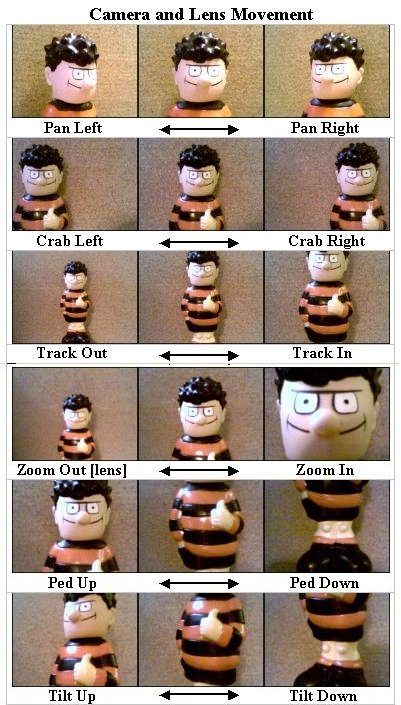 As you can see in the picture, the main movements are Pan Left, Pan Right, Crap Left, Crap Right, Track Out, Track In, Ped Up, Ped Down, Tilt Up, Tilt Down and for a lens movement Zooming Out and In.
Crabbing left and right is when the camera moves in a straight line and makes the image in the shot move from left to right or vise-versa. This doesn't give the audience a different view of the image in the shot, but it can reveal something near the image that you couldn't see in the previous frame before the crabbing started. I will be using this so the camera runs parallel with the character running, this is to make the audience feel like they are running with the character.
Tracking in and out is kind of like zooming although the whole camera is moving. It gives an effect of either revealing something which couldn't be seen before the tracking happened (tracking out) or by gaining more detail and making the audience feel more uncomfortable (tracking in) i will be tracking out in a point of view shot to make it feel like the character is getting dragged.
Peding up and down is where the camera starts of at a certain point and then moves up to normally show a persons head, or moves down to normally show a persons feet. This is used a lot in horrors as it can start of showing the persons hands which could have a weapon in and then ped up to show who has the weapon in there hand. I am not going to use this as i don't want to reveal to much about the characters.
Tilting up and down is kind of the same as peding up and down, but in Tilting the camera doesn't physically move up and down keeping the shot straight on, instead it just tilts up or down, again this can be used in horror films as while tilting up you gain more knowledge about the person in view and the person is then in a dominant figure in the frame so can be intimidating to the viewer. I am going to be using this as a point of view shot so that the the audience look up at a dominant figure in low key lighting, so they still cant identify them but can see them in a low angle shot to show there dominance over them.
Zooming in and out is where the camera stays still and just the lens moves either in closer showing the image in the shot in more detail and gives an uncomfortable feeling to the viewer or zooms out which can show the audience more and normally is used to show the location of the person in the shot. I am going to use tracking instead of this because tracking gives a better effect of someone being dragged then zooming will.
There are also over camera movements like Surveying Pan, which slowly searches a scene which can build to a climax. Or Hand-Held camera shot, this is where the audience can see what the person is seeing, in the chase part of my production i am planning on using this with deep breathing in the background to create a sense of chaos.
Tuesday, 22 November 2011
Research On Camera Distance
I have researched different types of camera distance in shots, and how they can give certain effects.
Establishing Shot is a used in an opening sequence to show the background and base where the production will be set.
 Extreme Long Shots, Long Shots, Medium long Shots, Medium Shots, Medium Close Ups,
Close Ups, Big Close Up And Extreme Close Up can be seen on the picture on the left, and they can give different effects to the viewer.
An Extreme Long Shot is where you can see the whole body in the shot and also a lot of the background, This can be used as an establishing shot to show where the production is set, i am planning on using this in my production at the beginning to show the setting of my film (The woods)
A Long Shot is where only the persons body is in the shot, this means the you can see everything the person is doing. This can be used to make the viewer feel comfortable as they can see everything the person is doing, this also means that you can focus on more that one specific object. I will use this shot in a short frame time to give the audience a sense of comfortableness and then make them uncomfortable again to add to the confusion.
A Medium Long Shot is a shot that shows the subjects head to there knees, this can be used in documentaries where they want to show social circumstances rather than individuals and what they are doing. I don't think i will be using this as i cant see it being that effective in my production.
A Medium Shot is a shot that shows the body from the head to the waist, this means that the viewer can still see arm gestures. This can be used to see two people in a tight presentation. I i will use this when the person is running so they can just see the waist and above so the audience start to fell on edge at what is below them.
A Medium Close Up is used to show the head and shoulders of the subject and show a small part of the scene. They can also show a sense of distance from the person although still quite close. I will be using this at the end to show the person leaning over the body, as it doesn't give too much detail, and as it will be very low lighting anyway you will just be able to see a outline.
A Close Up shows the person head and can focus on the detail of everything on the head. This can be used in a a conversation while using the 180 degree rule. I don't think i will be using this as there is no dialogue in my opening sequence as i want the audience to be thinking all the way through.
A Big Close up shows the person forehead to there chin, this can be used to show a persons feelings and there reactions to certain things. I also wont be using this in my opening sequence as i don't want the audience to see the feelings of the characters to keep them, feeling confused an on edge.
An Extreme Close up shows the subjects face from the eyes to the mouth, they can make a person feel uncomfortable as they are looking at someone very closely and they are not use to getting this much detail Also in some cultures 24 inches is seen as private space so to these people this can be very invasive. But they can also be good as they can show detail in the persons face and show really small emotions. I was thinking about using this in my final production as i want to make the identity of the person a secret for the first two minutes so this can be good as they will only get a extreme close up, so they still won't be able to know who the person is fully, and this might make them feel edgy and uncomfortable.
Subscribe to:
Comments (Atom)